
Profitable On Paper, Broke In The Bank: The Cash Illusion Gap That’s Quietly Killing Service Businesses
Why your P&L says profit but your bank says broke. The Cash Illusion Gap explained — plus a free 5-minute CEO Cash Audit for service founders.

There’s a specific kind of stress that only founder-CEOs of service businesses understand.
It happens around the 25th of the month. Payroll is in five days. You glance at your accounting software, and your dashboard cheerfully reports that you’re up 18% year-on-year. Net margin healthy. Revenue growing. You should feel good.
Then you open your bank app, and the number staring back doesn’t match the story your P&L is telling. There’s a gap. A worrying, sleep-stealing, “how is this possible?” gap.
You’re not alone. Roughly 72% of small business founders report anxiety driven by cash flow stress, not profitability. And in service businesses doing between $200K and $5M in revenue, the gap between what your accounts say and what your bank holds is the single most common reason owners feel one bad month away from a crisis.
There’s a name for this gap. We call it the Cash Illusion Gap — and once you can see it, you can close it.
This article is for the founder who is technically profitable, working harder than ever, and still can’t figure out where the money goes. By the end of it, you’ll understand what’s actually happening inside your business, what the five most common cash leaks look like in service companies, and how to get a real-time picture of your financial stability in under five minutes.
Why “Profit” And “Cash” Are Not The Same Thing
Most founders treat profit and cash as if they’re interchangeable. They aren’t — and the language used by accountants makes the confusion worse.
A profit figure on a P&L statement is an accounting outcome. It is the result of revenue earned (often before it’s been paid) minus expenses incurred (often before they’ve been paid). It also strips out big chunks of money that do leave your bank account — like loan capital repayments, asset purchases, owner drawings, and tax instalments — because accounting rules treat those as balance-sheet movements, not P&L items.
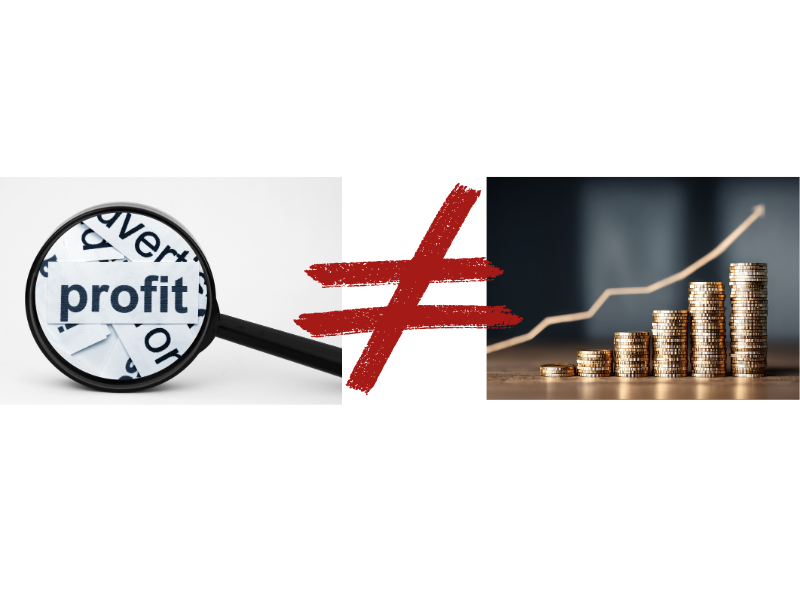
Cash, on the other hand, is binary. It is either in your account today or it isn’t. It doesn’t care about accruals, depreciation schedules, or matching principles. It only cares whether the money arrived.
In a service business, the gap between these two numbers is often enormous, because services are typically:
· Invoiced in arrears — you do the work, then you bill, then you wait 30–90 days to be paid.
· Front-loaded on costs — payroll, software, contractors, rent all leave your account in real time, regardless of when clients pay you.
· Light on assets — you have very little inventory or stock to convert into cash if things get tight.
The result: a service business can grow rapidly, post strong margins, and run out of cash. Growth actually makes the problem worse, because each new client engagement front-loads cost before it back-loads revenue.
The Five Hidden Drivers Of The Cash Illusion Gap
When we audit service businesses, the Cash Illusion Gap almost always comes from the same five sources. They’re not exciting, they’re not headline-worthy, and they’re exactly why your bank balance doesn’t match your P&L.
1. Unbilled and aged receivables
This is the silent killer. You delivered the work in March. You invoiced in April. The client’s accounts team queries the PO in May. They process it in June. You get paid in July. From your accountant’s perspective, that’s a March sale. From your bank’s perspective, it’s four months of carrying the cost with nothing coming in.
Multiply that across a year and you’ll often find 15–25% of your “revenue” is sitting in someone else’s accounts payable system.
Revenue leakage can make this problem worse, so ensure you actually invoice for all work done. You cannot even begin to try and collect what you have not even invoiced for.
2. Creeping payables you’ve stopped noticing
The flip side. A bill arrives, you forward it to the bookkeeper, it gets entered, it gets paid. The system works — but no one is looking at the pattern. Subscriptions that were $19 a month at signup are now $89. Three different team members signed up for three different project management tools. Your “marketing” line has crept from 4% to 11% of revenue across two years.
None of this is fraud. It’s drift. And drift, compounded, is a profit killer.
3. Recurring software and “small” monthly spend
This deserves its own category because it’s where most service businesses leak the most money relative to value received. The average $1M service business carries 30–60 recurring subscriptions. A meaningful percentage of them are duplicates, abandoned, or used by one person who left six months ago.
If you audited your last 90 days of card statements and asked one question — “would I sign up for this today, at this price, knowing what I now know?” — you would likely cancel 20–30% of recurring spend without affecting operations.
4. Tax sitting in the wrong account
If you’re not ring-fencing tax obligations the moment revenue lands, you are effectively borrowing from your future self at 0% interest, and then being surprised when the bill arrives. Founders who run businesses this way feel “rich” mid-quarter and “broke” at quarter-end. The cash was never really yours.
The fix is mechanical: a separate account, an automatic transfer of an estimated tax percentage every time revenue is received, and a refusal to ever borrow from it. Boring. Transformational.
5. Owner drawings disguised as expenses
This one is uncomfortable, but it’s where a lot of founder-led businesses lose visibility. Personal subscriptions, mixed-use vehicles, “team lunches” that were really family meals, home office equipment that’s mostly used for non-work. Each item alone is small. Collectively, they distort both your profitability and your cash position, and they make it impossible to know the real economics of your business.
If you ever want to raise funding, sell the business, or even just hand over financial control to a CFO, this clean-up has to happen.
The Compounding Cost Of Operating Without Visibility
Here’s what’s quietly happening when you can’t see the Cash Illusion Gap clearly:
· You make growth decisions on the wrong number. You hire because the P&L looks healthy. Cash arrives slower than payroll, and you compound the gap.
· You raise capital from a position of weakness. Investors will eventually ask for a 90-day cash forecast. If you build it for the first time in the middle of a fundraise, it shows.
· You under-price. Without a clean view of true cost-to-serve, you set prices based on competitor benchmarks instead of your own economics. Margin erodes invisibly.
· You lose negotiating leverage with clients. You can’t enforce payment terms confidently because you don’t know how much cash a 60-day delay actually costs you.
· You burn out. Cash flow anxiety is uniquely corrosive because it’s both constant and invisible to everyone else. Your team sees a growing business. You see a fragile one.
None of these failure modes show up in a single bad month. They compound over quarters and years, and they’re the reason most service businesses plateau between $1M and $3M in revenue and never break through.
What “Financial Stability” Actually Looks Like
A financially stable service business — the kind that scales, survives downturns, raises capital, and eventually exits at a real multiple — shares five characteristics. None of them require an in-house CFO or expensive software.
1. A 30-day forward cash view, updated weekly. Not a budget. Not a forecast for the bank. A live, deterministic projection of cash in, cash out, and tax owed for the next four weeks.
2. A 90-day rolling view of receivables, aged and prioritised. You know exactly who owes you what, for how long, and which three calls you need to make this week to unlock cash.
3. A monthly close rhythm. Even a lightweight one. Books closed within 10 days of month-end. P&L and cash reviewed against the previous three months. Revenue leakage addressed. Anomalies flagged.
4. A defensible Net Profit number, calculated ex-VAT/GST. The same number you’d hand to a lender, an investor, or an acquirer without flinching.
5. A stability score you check regularly. A single 0–100 number that tells you whether your business is financially resilient, fragile, or in trouble — and updates as your numbers change.
Most founder-led service businesses have none of these. The ones that get to 3, 4, and 5 are almost always the ones still standing five years later.
How To Close The Cash Illusion Gap In 5 Minutes
You don’t need a CFO to start. You need a diagnostic that tells you, honestly, where the gap is in your business.
The free 7-Day CEO Cash Audit was built for exactly this. It is a chartered-accountant-designed assessment that takes around five minutes, requires no payment, no sign-up to a long email funnel, no software integration, and no uploading of your data.
You enter four sets of numbers from your bank app, your invoicing tool, and your last week of activity:
· Last 7 days: revenue received, expenses paid
· Outstanding: invoices owed to you, bills you owe
· Cash position: current bank balance, recurring weekly costs
· Upcoming: largest expense + days until it’s due
Estimates are fine. Nothing is uploaded or stored on a server.
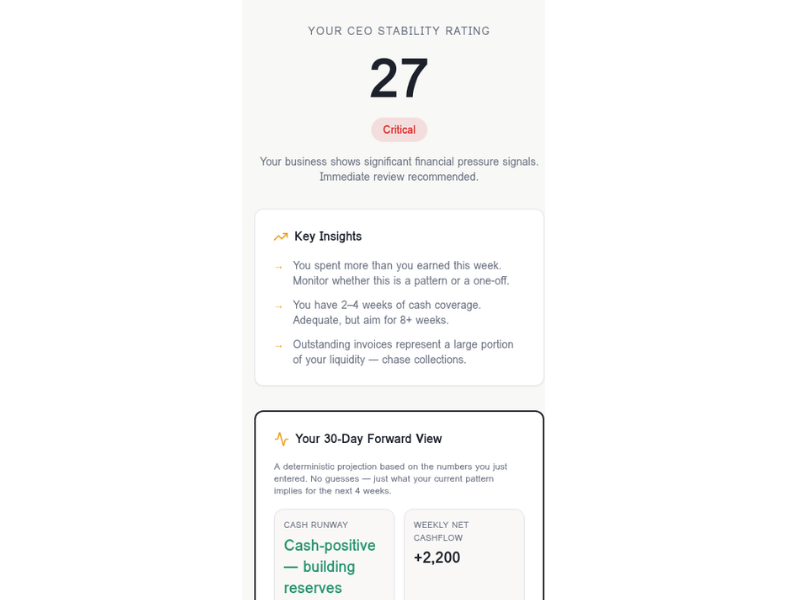
The audit then returns three things, instantly, on screen:
1. Your CEO Stability Rating — a 0–100 score that tells you where you stand: Critical, Unstable, Stable, or Strong.
2. A 30-day forward cash view — your projected runway in days and your weekly net cashflow, based on the pattern your current numbers imply.
3. Your top hidden leaks — the specific signals in your numbers that are pulling cash out of your business right now, with the next three priorities to address.
It is, deliberately, not a sales funnel dressed up as a tool. It is the first step of a two-step system designed to give founders genuine clarity before asking for anything in return.
If your score reveals deeper structural issues — fragile governance, recurring spend you didn’t see, a runway shorter than you thought — the paid 90-Day CEO Audit is the second step. It expands the same diagnostic across a full 90-day period, builds a 6-month forward cash forecast with gap dates, runs scenario modelling, and produces a 4-week stabilisation plan. But that’s only if and when you decide you want it.
What Changes Once You Can See The Gap
Founders who run this diagnostic for the first time usually have one of two reactions.
The first is relief. The numbers turn out to be better than they feared. The anxiety was disproportionate to the data. They can now make decisions — about hiring, about pricing, about a new market — from a position of clarity rather than dread.
The second is the harder one: confirmation. The numbers are exactly as worrying as they suspected. But for the first time, the problem has shape. It is no longer “I’m anxious about cash”; it is “my recurring spend is 14% of revenue and my receivables are aged at 67 days.” Problems with shape are problems you can solve.
Either way, the Cash Illusion Gap stops being invisible. And once it stops being invisible, it stops being inevitable.
The Next Move
If you’ve read this far, you almost certainly recognise yourself somewhere in this article. The discomfort that brought you here is a signal worth listening to — not because something is necessarily wrong with your business, but because something is unclear about it. Unclear is fixable. Unclear in 90 days, in fact, if you start now.
Take the free 7-Day CEO Cash Audit. Five minutes. No payment. No upload. On-screen results.
You’ll know your CEO Stability Rating before your next cup of coffee is cold. And you’ll have the first honest view of your business’s cash position you’ve had in a long time.
The 7-Day CEO Cash Audit is Step 1 of the CEO Financial Review System — a two-step diagnostic and remediation system for service-business founders doing $200K–$5M who want CFO-level financial clarity without hiring a CFO.